
Before the Screens Come On: Why I Still Make Things with My Hands
Lilli • April 11, 2026
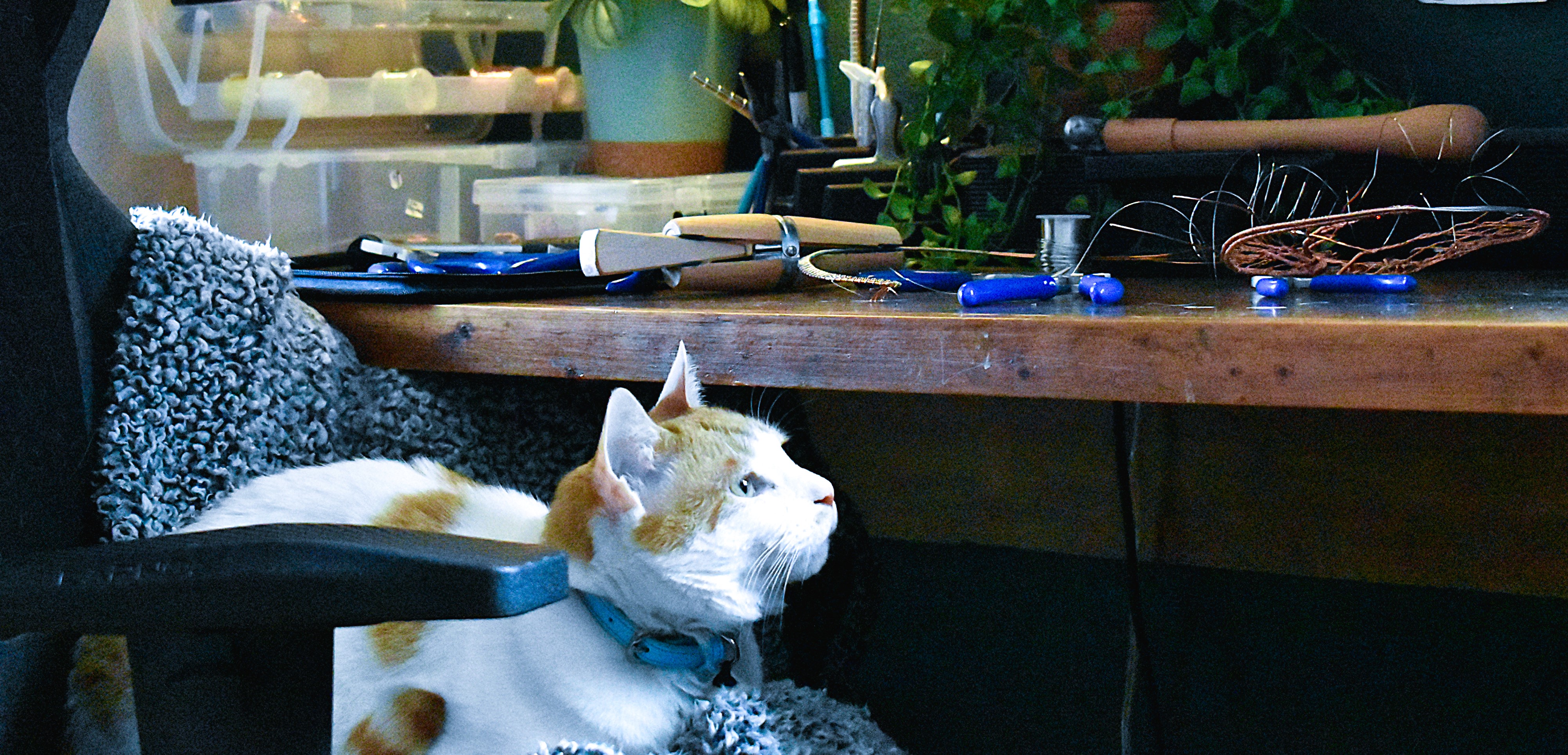
There is a window of time in the morning that belongs only to me.
The birds find it first. They start before the light does — small sounds, tentative, like they're testing whether the day is safe yet. Then the sky begins to warm, and the golden hour does what it always does: makes everything look like it was always supposed to be exactly this way.
I'm in my office by then. Wrapped in a blanket, tea nearby, a cat having already claimed my lap as if that was the plan all along. Around me: wire, tools, a project I've been working on for weeks. No screens yet. No notifications. No version of myself that belongs to anyone else.
This is where I make things.
Not for productivity. Not for a portfolio. Not because there's a market for it or a deadline attached. I make things because something in my nervous system requires it — the same way it requires sleep and water and the sound of birds deciding the day is safe.
I didn't always understand that. For a long time, I apologized for it.
The Hours That Hold the Day
Somewhere along the way I realized my hands-on time wasn't random. It was structural.
Mornings are for making before the world arrives. The wire wrapping, the macrame, the quiet turning of something raw into something intentional. This happens before any screen comes on, before any task claims my attention. It is thinking time disguised as making time. My hands are busy so my mind can move freely, following threads the way it wants to, without the pressure of a blank document staring back.
Evenings are different. By then the day has asked enough of me. I'll settle on the couch with a few rows of knitting, sitting next to my partner while he watches his show. No agenda. No output target. Just the rhythm of the needles and the quiet company of someone I love. My body starts producing the melatonin it needs. My nervous system gets the signal: we are done now. We can rest.
Two different times, two different needs, the same solution.
That is what most conversations about hobbies miss entirely. They treat making things as a reward you earn after real work is done — a little treat you squeeze into the margins if you have been productive enough to deserve it. But that framing has it backwards.
For a brain that spends its days debugging invisible logic, building systems that live entirely in electricity, the physical act of making something is not a luxury. It is load-bearing. It holds the structure of the day up at both ends, and without it, something in me starts to sag.

The Permission Problem
I don't remember the first time a hobby felt like a waste of time. What I remember is the pattern that came after every new interest: "You haven't even finished the last thing."
It didn't matter that the new interest was in a completely different category. It didn't matter that the previous project was still very much alive, just moving at its own pace. The message was the same every time: you don't get to start something new until the old thing is done. Curiosity had to be earned. Enthusiasm had to wait in line.
I carried that for a long time.
Even now, sitting down to wire wrap on a quiet morning requires a small act of negotiation with myself. The dishes will still be there. The code will still exist. The things I think I should be doing can wait until it's actually the right moment to do them. That last part matters more than it sounds: doing something I should do when I don't have the capacity doesn't produce discipline. It produces burnout and below-average work.
But when I rest — when I actually do the thing I want to do — something shifts. When I eventually return to the work I was avoiding, it has become the thing I want to do. And the quality difference is not subtle.
The guilt, when it shows up now, is mostly external. Someone waiting on a project. Someone who assumed that because it's been a while, I must have abandoned it. But the guilt I feel internally? It's mostly fleeting. A flicker of "it's been weeks" followed quickly by muscle memory taking over, hands finding their rhythm again like no time has passed at all.
I've learned to tell the difference between guilt that belongs to me and guilt that was handed to me a long time ago. Most of it was handed to me. I'm still returning it.
And the monetization question — the one that used to stop me cold: why do it if it doesn't make money? I've made my peace with it. Not because I couldn't monetize these things, but because the moment I attach revenue to something I love, it stops being mine. It becomes something I produce. And these things — the wire, the yarn, the tiny carefully placed pieces — these are not products. They are how I stay whole.
The Things That Travel With You
Some projects have a purpose from the start. Others find one along the way.
I've written before about knowing which projects to release — the ones you've outgrown, the seeds planted in the wrong season. These aren't those. These are the ones that stay.
I started a macrame curtain months ago because I wanted to weave glass jars into it for herbs and plants — fresh herbs for cooking, suspended somewhere the cats couldn't stage a raid. Practical, joyful, completely mine. It's still in progress. The herbs are waiting patiently.
One of my wire wrapped pieces exists because I was upset. I sat down, hands needing something to do, and made something. It turned out well enough that when I posted it, people noticed. My partner wanted to display it in the house. A bad day became a permanent, beautiful object. That's a kind of alchemy I don't take for granted.
And then there's the blanket.
I started knitting it years ago without knowing why. No pattern in mind, no recipient, no plan. Just yarn and needles and the meditative click of making rows. Somewhere along the six years it has been in progress, it became obvious who it was for. My partner's love language includes being under a blanket together — coding side by side, watching something, just existing in the same space. The blanket, without me deciding this consciously, had been growing toward him the entire time.
It's massive now. Still not finished. And every row I add in the evenings, sitting next to him while he watches his show, is both the making and the message.
These projects are not unfinished. They are companions. They travel with me through seasons, through moods, through years. They hold memories the way objects do — not as archives but as living things, still becoming.
What Making Actually Does
There is a reason I reach for wire on a hard morning and needles on a long evening. It isn't aesthetic. It isn't discipline. It's regulation.
When everything I work with is invisible — logic, systems, code that lives in electricity — my hands start to need proof that they can do something. Copper wire is tangible in a way that a pull request is not. A knot in macrame has weight. A completed row of knitting is a small, undeniable fact in a day full of abstractions.
This isn't unique to me. Tactile, repetitive making has been a human need long before screens existed to compete with it. We have always needed to build things we could hold. The needle, the loom, the wire — these aren't hobbies in the modern sense of the word. They are technologies for staying grounded.
For a brain wired to hyperfocus and burn bright, making things with your hands is maintenance. Not the kind of maintenance you schedule reluctantly, but the kind that keeps the whole system running at the level it's capable of. A garden that never gets tended doesn't rest — it exhausts itself. The maker's equivalent of tending is exactly this: copper wire at a quiet desk, yarn on a couch, a macrame knot tied while the herbs grow patient nearby.
Sometimes the impulse arrives without warning. I'll be mid-afternoon, completely unplanned, and suddenly I need to make something. I once had a random idea for a macrame towel holder for the kitchen — saw the problem, felt the solution, sat down and made it. It now holds the kitchen towel at exactly the right height. That sudden creative aliveness is its own kind of information. The body knows what it needs before the brain finishes the sentence.

On Timelines That Belong to You
A six-year blanket. A month-old wire wrap. A macrame curtain that's been waiting since last season. A puzzle on the table with one piece somewhere in the universe.
None of these are failures. They are things being done at the pace they need to be done.
There is no rule that says a project must be finished before you're allowed to start the next one. There is no timeline that applies to everyone. The blanket will be done when it's done, and when it arrives in my partner's lap on a winter evening, it will have been worth every row I added slowly over years. The macrame curtain will hold its herbs when the herbs are ready to grow. The wire wrap will be completed when my hands are ready to complete it.
Things are done right when they should be done. That is not an excuse. It is an ecology.
So if you have a corner of your home where something unfinished lives — if you have a project you've been "meaning to get back to" for longer than feels acceptable — I want you to consider that it might not be waiting because you failed it. It might be waiting because it's a companion, not a deadline. It might be waiting because the season for it hasn't arrived yet.
Pick it up when it calls to you. Put it down when you need to. Let it travel with you at its own pace.
And if someone asks when you're going to finish it, you can tell them: when it's ready.
Let's Get to Work
Your hands already know what your brain sometimes forgets. Making things — slowly, imperfectly, across years if necessary — is not a detour from your real work. It is part of what makes the real work possible.
Protect the morning hours before the screens come on. Protect the evening rows and the quiet rituals. Protect the projects that don't have deadlines or revenue attached to them.
They are load-bearing. Even when they don't look like it.
🌱 Over to You: What are you making right now — even slowly, even quietly, even without knowing quite why? I'd love to hear about the thing that's traveling with you. Drop it in the comments.
Comments
No comments yet. Be the first to share your thoughts!