
The Thinking Mirror: How I Use AI Without Letting It Think for Me
Lilli • May 2, 2026
Let me say the quiet part loud: I build AI, and I still don't fully trust it.
Not because I think it's dangerous in some sci-fi, robot-uprising kind of way. But because I know what it actually is. I know what's under the hood. And when you understand that AI is fundamentally a pattern recognition system — that it's finding and reflecting patterns in data, not thinking — you start using it very differently than the people posting their "I let AI run my entire life for 30 days" experiments.
This is not a post telling you to automate everything. It's not a list of prompts that will change your workflow forever. It's an honest account of what it actually looks like to use AI when you build it, live with a non-linear brain, and have a healthy distrust of anything you don't fully understand.
What AI Actually Is (And Why It Matters That You Know)
Somewhere along the way, we started talking about AI like it's a very smart colleague sitting in your computer. People ask it for opinions. They take its output at face value. They've built entire careers around the skill of "prompting," as if asking a system a question well is the same as understanding what the system is doing.
It's not.
AI is pattern recognition software. Extraordinarily sophisticated pattern recognition, but pattern recognition nonetheless. It finds shapes in data and reflects them back. When you ask it a question, it's not reasoning through the answer the way you would. It's producing the most statistically likely response based on everything it was trained on. That's genuinely useful. It's also genuinely limited — and the people who don't understand the limitation are the ones getting burned.
This matters because the way you relate to a tool changes completely when you understand what it is. A hammer doesn't think. You don't ask a hammer for its opinion on where the nail should go. When you understand that AI is a tool with a very specific function, you stop treating it like an authority and start treating it like infrastructure.
That shift is everything.
What It Actually Does For My Brain
My brain runs on parallel processes. I'm usually managing multiple projects at once, and my thoughts move faster than any linear note-taking system can keep up with. For a long time, that felt like a problem. Now, I think of it as my native architecture — it just needs the right environment to work well.
AI fits into that environment in specific, practical ways.
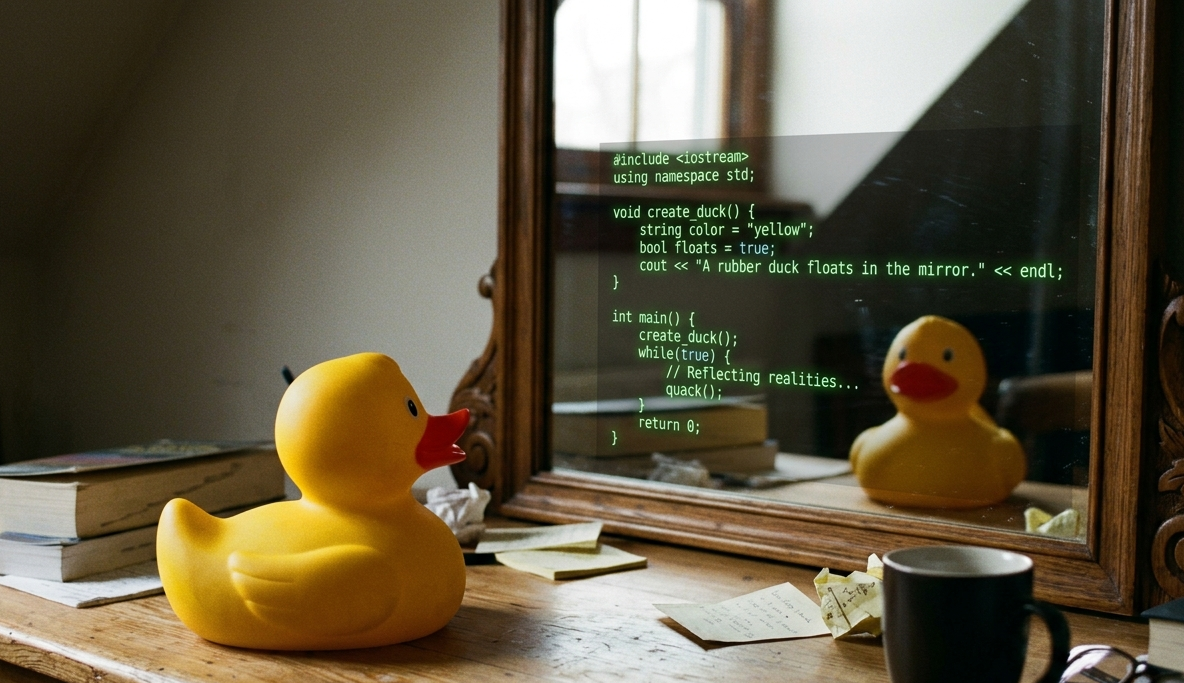
The biggest one is thinking out loud. When I'm working through a business idea, a technical problem, or something I'm trying to understand, I can have a full back-and-forth conversation with AI and play out every possible direction. Not because AI is right, but because articulating your thinking to something that responds — even something that doesn't truly understand — forces you to organize what you actually believe. It's less like asking an expert and more like talking to a very patient mirror. The reflection helps you see yourself more clearly.
It also helps me comprehend things I'd otherwise have to read four different articles to piece together. Complex topics, new frameworks, things where I don't even know the right terminology to google yet — I can ask, push back, ask again, and get explanations that meet me where I am. That's not a small thing for a brain that needs to understand the why before it can hold onto the what.
And then there are the unglamorous use cases, which are honestly my favorites to talk about because they're the most real. Meal ideas when I have specific fridge constraints. Home repair questions where I can upload photos and ask "is this a professional situation or a weekend fix?" instead of searching terms I don't know on Google and risking an expensive wrong call. Small friction points that used to take disproportionate mental energy, now handled in a few exchanges.
Nothing falls apart without AI. Things just slow down. That distinction matters to me, because the goal was never dependency — it was support.
The App That Came From Trying to Time Block Myself
I want to tell you about how Wildbloom happened, because it's the most honest example I have of what AI as a collaborator actually looks like in practice.
I wasn't trying to build an app. I was trying to time block my day.
When I started working through the idea with AI, something shifted in the conversation. The more I talked through what I actually needed — tasks that matched my energy, not my calendar; space for brain dumping without structure; the ability to record what I actually did instead of only what I planned — the more I realized I wasn't describing a time blocking system. I was describing something different. Something that treats productivity as an energy ecosystem rather than a schedule.
That conversation didn't build the app. I built the app. But the back-and-forth helped me see the shape of what I was actually trying to solve. That's the collaborator version of AI working: not AI doing the thinking, but AI creating enough structure around your thinking that you can see it clearly.
Wildbloom, the energy-mapping app that came out of that process, is now in soft launch — and the heuristic AI feature I'm building into it is designed around exactly this philosophy. Your data stays yours. If you delete it, the AI model built on it is deleted too. The goal is a tool that learns your patterns to reduce decision fatigue, not a system that owns your information.
That distinction feels important to me, and it came directly from knowing how this technology works.

The Part Nobody Talks About
The AI industry has a structural incentive problem.
When a tool is moving fast and the outcomes are visible, the people who learn it quickest get rewarded first — regardless of whether they understand it deeply. That created a wave of people teaching AI use before they'd had time to develop a genuine relationship with its limitations. Not out of bad intentions, but because the moment rewarded speed over depth.
The result is a lot of received wisdom about AI that hasn't been tested. Workflows that look productive but are quietly accumulating fragile dependencies. Products with AI features built in not because the product needed them, but because "AI-powered" became a signal of legitimacy. And users who've outsourced enough of their process that when something breaks, they don't know where to look.
None of this is a character flaw. It's what happens when a powerful tool gets normalized faster than understanding can catch up.
The question worth sitting with isn't "am I using AI enough?" It's "do I understand what I'm actually handing off — and what that costs me when it's wrong?"
How I Actually Decide When to Use It
I treat AI the way I think about any tool in an ecosystem: where does it fit, and where does it not?
It fits when I need a thinking mirror — when I'm circling an idea and need something to push against. It fits when the task requires pattern-finding, synthesis, or explaining something complex in a different way. It fits for the small, practical things that used to create unnecessary cognitive drag.
It doesn't fit when I need a judgment call. It doesn't replace the human expertise of knowing which contractor to actually hire, which business decision to actually make, which creative direction actually resonates. It can help me get there. It can't get there for me.
The gardening version of this: AI is good soil amendment. It makes the conditions better for growth. But I'm still the one deciding what to plant, and I'm still the one doing the tending. Healthy soil doesn't grow anything without a gardener who knows her own garden.
What This Means for You
You don't need to build AI to use it well. But you do need to have a clear-eyed relationship with what it is.
Try starting here: use it for the thing that's actually slowing you down, not the thing that sounds most impressive to optimize. Use it as a conversation partner, not an authority. Ask it to help you think, not to think for you. And if something it produces feels off, trust that instinct. Question it. Push back. You're allowed to do that.
You're not behind if you're not automating everything. You're not doing it wrong if your AI use looks different from the person in your feed. The goal isn't maximum AI integration. The goal is a workflow that works with your brain, not against it.
And if you've been hesitant because it all feels like too much, or too fast, or too full of people who seem to know more than you: that hesitation might be the most intelligent response in the room.
🌱 Over to You: How are you actually using AI right now — and what's one place you've tried it that genuinely didn't fit? I want to hear the real version, not the optimized one.
Comments
No comments yet. Be the first to share your thoughts!